
Most network marketing businesses don't start with software. They start with a WhatsApp group, an Excel sheet, and one person who knows how the commissions are supposed to work. That setup holds up for a while—maybe fifty distributors, maybe two hundred. Then someone joins under the wrong sponsor, a payout cycle gets calculated twice, a distributor disputes a level bonus, and suddenly a single spreadsheet error is costing you money and credibility at the same time.
That's usually the point at which a business starts looking seriously at MLM software development in Panipat or anywhere else. Not because the software is exciting, but because manual tracking has a hard ceiling. Genealogy trees grow sideways as much as downward. Compensation plans have conditions, caps, and rank qualifications that don't translate well into formulas. Payout records need an audit trail. And distributors—reasonably—expect to log in and see their own numbers instead of waiting for a monthly message.
Panipat has a substantial base of trading, textile, manufacturing, and distribution businesses, and direct-selling and referral-driven models are common across Haryana. Working with a local MLM software company in Panipat has a practical advantage: requirement discussions happen face to face, your compensation logic gets explained once and understood properly, and support conversations don't stall across time zones.
Also read:
Website Development Company in Sonipat
Wave Fusion IT Solutions works with businesses that need custom MLM software built around their actual plan rather than a template that almost fits. This guide covers what MLM software does, which features matter, how development works, what drives cost, and what to ask before hiring any MLM software development company in Panipat.
What Is MLM Software?
MLM software is a platform that automates member registration, network structure, referral tracking, commission calculation, and payouts for multi-level or network marketing businesses. It replaces manual record-keeping with a system that applies your compensation rules consistently and gives both admins and distributors a live view of the network.
A working MLM system usually handles these areas:
Member registration. A new distributor signs up through a referral link or sponsor ID. The system validates the sponsor, places the member at the correct position in the network, and creates their account—without an admin manually assigning placement.
Distributor and member management. Admins can search members, view their sponsor and upline, activate or deactivate accounts, update ranks, and check KYC status from one place.
Referral tracking. Every joining is traced back to the sponsor who introduced it. If a distributor shares a link that brings in twelve members over a quarter, the system knows exactly which twelve and when.
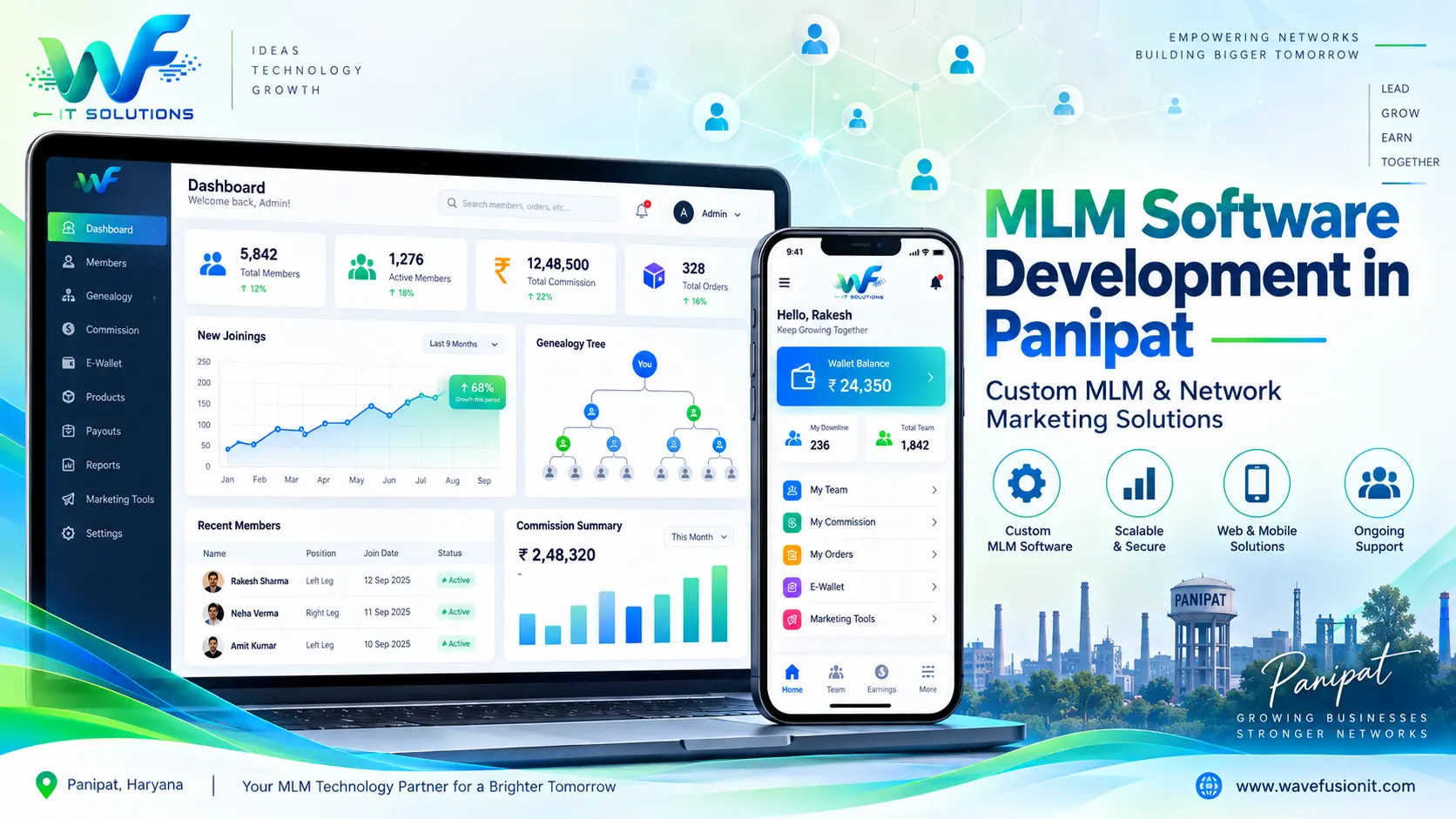
Genealogy/tree management. A visual downline tree showing placement, levels, active/inactive status, and business volume under each leg. For a binary plan, this is where you check left-leg versus right-leg volume at a glance.
Commission calculation. The engine that applies your plan rules—level income, matching bonus, pairing income, rank rewards, caps, and qualification conditions—automatically at the end of each cycle.
Payout management. Approved commissions move into payout batches, with TDS or admin charge deductions applied, plus a record of what was paid, to whom, and when.
Wallet. An internal balance where earnings accumulate before withdrawal, often split into e-wallet, purchase wallet, and payout wallet depending on the business model.
Reports. Joining reports, volume reports, commission summaries, payout histories, and rank-wise performance data.
Admin dashboard. Central control—approvals, plan configuration, announcements, financial overview, and user management.
User dashboard. The distributor's own view: earnings, downline, referrals, wallet balance, orders, and withdrawal requests.
How does MLM software work?
A member joins through a sponsor's referral link; the system places them in the genealogy tree, tracks their purchases or business volume, and runs those volumes through the compensation plan to calculate commissions for everyone eligible in the upline. Earnings post to wallets, payout requests move through admin approval, and every step is logged. The business rules change from company to company—the underlying flow doesn't.
Why Businesses Need Custom MLM Software
Ready-made MLM scripts exist, and they're inexpensive. They also assume your business works the way the script's author imagined. Here's where that assumption usually breaks.
Business-specific compensation plans. Very few real plans are textbook binary or textbook unilevel. Businesses add a repurchase bonus, a leadership pool, a capping rule, or a rank qualification that depends on both legs. Editing a packaged script to support that is often harder than building the logic properly from the start.
Scalability. A system that calculates commissions for 500 members by looping through the entire tree will crawl at 50,000 members. Custom MLM software solutions can be architected with indexed genealogy structures, queued commission jobs, and a database designed for depth—decisions that are difficult to retrofit later.
Automation. Manual approval of every joining, every payout, and every rank upgrade eats admin hours. Custom development lets you automate what should be automatic and keep manual control where it genuinely matters, like KYC verification and withdrawal approval.
Better reporting. Off-the-shelf reports tell you totals. Your business may need leg-wise volume trends, distributor churn by joining month, or payout liability projected for the next cycle. Those are custom queries.
User experience. Distributors judge your company partly by the panel they log into. A slow, cluttered dashboard creates support tickets and doubt.
Integrations. Payment gateways, SMS and WhatsApp APIs, email services, e-commerce catalogues, accounting software, and logistics tracking. Each one is an integration point a generic script may or may not support.
Security. You're storing PAN numbers, bank details, Aadhaar-linked KYC documents, and transaction histories. That demands encrypted storage, role-based access, protected APIs, and proper audit logging—not an afterthought.
Custom admin controls. Different staff need different access. Your accounts person shouldn't be able to edit the compensation plan.
Mobile accessibility. Most distributors will check earnings on a phone. A responsive web panel is the minimum; a dedicated MLM mobile app is increasingly the expectation.
MLM Software Development in Panipat—What Should a Business Look For?
If you're evaluating an MLM software development company in Panipat, the sales pitch matters far less than the answers to a handful of technical and process questions.
Technical expertise. Ask what stack they use and why. Ask how they'd handle commission calculation for a network several levels deep. A developer who has genuinely built MLM systems will talk about tree traversal, transaction integrity, and calculation cycles—not just screens.
Custom development capability. There's a real difference between a company that installs and skins an existing script and one that writes your plan logic. Both are valid choices at different budgets. You should know which one you're buying.
Security practices. Ask about password hashing, HTTPS, database encryption for sensitive fields, SQL injection protection, admin activity logs, and how payout approvals are protected.
Scalability. Ask directly: what happens at 10,000 members? At 100,000? A thoughtful answer involves database indexing, caching, and background job processing.
UI/UX. Request to see actual dashboards they've built. Genealogy trees in particular are hard to present clearly—that's a good test of design maturity.
Mobile responsiveness. Open their demo on a phone. If the tree view or the wallet page breaks, you've learned something useful.
API integrations. Payment gateway, SMS, KYC verification, e-commerce. Ask which they've implemented before.
Support and maintenance. MLM software isn't finished at launch. Plans change, rules get added, and gateways update their SDKs. Know what post-launch support includes and what it costs.
Project communication. Who is your point of contact? How often do you see progress? Working with a local MLM software developer in Panipat should mean you can sit across a table when the compensation logic gets complicated.
Transparent development process. Milestones, deliverables, testing phase, and handover documentation. Vague timelines usually mean vague planning.
Key Features of Modern MLM Software
Features only matter in terms of what they let your business do. Here's the practical value of each.
Admin Dashboard
The control room. Total members, active members, today's joinings, pending payouts, wallet liability, and recent activity in one view. Business value: you see problems—a payout backlog, a drop in joinings—while they're still small.
Distributor/User Dashboard
Each member's personal view: earnings breakdown, downline count, referral link, wallet balance, and withdrawal status. Business value: distributors self-serve instead of calling your support team for numbers.
Registration & Login System
Sponsor-validated signup, OTP verification, secure password handling, and session management. Business value: placement errors at joining are expensive to unwind later; validation at the entry point prevents them.
Referral Management
Unique referral links and IDs, joining source tracking, and referral performance reports. Business value: you can identify which distributors actually drive network growth and structure recognition around real data.
Genealogy Tree
An interactive downline view with search, level navigation, and volume display per node. Business value: leaders can see where their network is unbalanced and act on it—which is the whole point of a network business.
Commission Management
A rules engine implementing your plan: level income, pair matching, rank bonuses, caps, qualification criteria, and calculation cycles. Business value: consistent, reproducible, defensible calculations. Commission disputes are the fastest way to lose good distributors.
Wallet & Payout Management
Multiple wallet types, internal transfers, withdrawal requests, deduction rules, admin approval, and complete transaction history. Business value: clean financial records and controlled cash outflow.
Sales & Performance Reports
Joining trends, business volume by period, rank distribution, payout summaries, and exportable data for your accountant. Business value: decisions based on numbers rather than impressions.
Notifications
Email, SMS, or in-app alerts for joinings, commission credits, payout approvals, and announcements. Business value: distributors stay informed without your team sending manual updates.
KYC/Document Management
Document upload, admin verification workflow, and status tracking tied to payout eligibility. Business value: compliance discipline and a clear rule that unverified accounts don't withdraw.
Payment Gateway Integration
Online joining fees and product purchases through Indian gateways, with automatic transaction reconciliation. Business value: no manual matching of bank transfers against member IDs.
Mobile-Friendly Interface
Responsive layouts, or a dedicated Android/iOS app. Business value: your distributors are mobile-first, and adoption follows convenience.
Security & Access Control
Role-based permissions, encrypted sensitive data, activity logs, and protected admin routes. Business value: you limit the damage a single compromised account can do.
Types of MLM Software We Can Develop
The right structure depends entirely on your legitimate business model, product, and compensation rules. These are the common architectures:
- Binary MLM Software—two positions under each member, left and right leg, with pairing or matching income. Requires careful handling of carry-forward volume and capping.
- Matrix MLM Software—fixed width and depth (3×3, 5×7, and similar), with spillover placement logic.
- Unilevel MLM Software—unlimited frontline width, income calculated by level depth. Simpler structure, but level-wise calculation must stay efficient at scale.
- Hybrid MLM Software—combinations, such as a binary placement structure with unilevel-level income layered on top.
- Board Plan MLM Software—members fill positions on a board that splits on completion.
- Custom Compensation Plan Software—your own rules, your own bonus types, built from a written plan document.
- Network Marketing Management Software—broader distributor, inventory, and order management for direct selling operations that need more than commission handling.
Before development begins, your compensation plan should be documented in writing, condition by condition. Ambiguity in the plan document becomes ambiguity in the code.
Custom MLM Software Development vs Ready-Made MLM Software
| Factor | Custom MLM Software | Ready-Made MLM Software |
|---|---|---|
| Customization | Built to your exact plan, rules, and workflow | Limited to available settings; complex rules may not fit |
| Scalability | Architected for expected network size and growth | Depends on the original build; may need reworking later |
| Features | Only what you need, plus what you add later | Everything included, useful or not; new features may not be possible. |
| Branding | Full control of design, identity, and experience | Template-based; similar to other deployments |
| Integrations | Any gateway or API your business requires | Restricted to what the product supports |
| Security | Practices chosen and documented for your build | Varies widely by vendor; harder to independently verify |
| Long-Term Flexibility | Source code and roadmap under your control | Vendor-dependent for changes and upgrades |
| Development Cost | Higher upfront, lower cost of major changes later | Lower upfront, potential rebuild cost if you outgrow it |
Neither option is automatically correct. A small business testing a simple unilevel model with a few hundred members may be well served by a packaged solution. A business with a distinctive plan, real growth expectations, or compliance requirements is generally better off with custom MLM software development.
MLM Software Development Process at Wave Fusion IT Solutions
1. Analyzing requirements. An interactive session covering your business plan, model document, the expected volume of users, and features that you should have. Every detail is recorded.
2. Understanding of the business model. The process of understanding the process of compensation step-by-step, such as caps, conditions, qualification, frequency of calculation, and edge situations. This is the stage that prevents much later work.
3. Planning features. Determining what's going to be initially released and the ones that follow in order to avoid delays due to irrelevant features.
4. Design of UI/UX. Wireframes, screen layouts, and wireframes for the distributor and administrator panels are reviewed prior to when any code is created.
5. Software development. Development in modules Registration, tree the wallet, commission engine, reports, and review points, rather than one quiet stage.
6. Development of APIs and databases. Schema designed for genealogy depth and integrity of transactions; APIs to mobile applications and third-party service providers.
7. Security checks and testing. Functional tests and verification of commission calculation against manual data load tests, as well as verification of security controls and access control, as well as processing of data.
8. Installation. Setup of the server, SSL, backups, and finally, go-live.
9. Training. Guides to your administrative team. documents for your day-to-day activities.
10. Support and maintenance. Fixes for bugs, updates, and upgrades in the event that your plans and network change.
MLM Software Development Cost in India
What is the cost of MLM software development costs in India?
It is not a cost that is fixed for HTML0—MLM development costs for software in India are contingent on the scope of work, and a reliable quote comes only when your needs are recorded. Anyone quoting an exact figure without understanding your compensation strategy is guesswork.
The factors mentioned above change the numbers:
- The number of features. A core system, which includes registration, tree commissions, wallets, and report costs, is much less than one with e-commerce tickets, inventory, and the ability to support multiple currencies.
- Complexity of the compensation plan. A straightforward unilevel program is simple to set up. An alternative plan that includes ranking qualifications, matching bonuses pooling, capping, and matching rules will require a significant amount of development and testing.
- Web-only vs. web with mobile application. Adding Android and iOS apps requires more creation, API development tests, and the deployment of stores.
- Administrator dashboard depth. Basic management versus the ability to customize the panel so that the plan's parameters are editable with no need for a developer.
- Integration of payment gateways. One gateway is normal; multiple gateways that have automated reconciliation is a lot of work.
- Integrations from third-party providers. SMS, WhatsApp email, KYC verification, accounting logistics, and KYC verification—each one adds scope.
- Customized UX/UI. Template-based design versus entirely custom-designed screens based on your company's brand.
- Security specifications. Standard practices versus more secure encryption, thorough audit logs, and formal penetration tests.
- hosting and installation. Shared hosting versus cloud infrastructure that can handle your anticipated demand.
- Maintenance. Ongoing support is generally priced per month or every year.
A more practical method is to write the plan down and your wish list of features and then inquire for a quotation based on requirements that includes a breakdown of modules. This also allows you to assess vendors on comparable specifications.
What is the time frame to design and develop MLM software?
Timelines are based on their scope. However, a clearly defined customized MLM system is usually more of a multi-month undertaking than a week-long timeframe. A focused web platform with a standard program is more efficient; however, including mobile apps, many integrations, and the complexity of planning logic can extend the plan. Request a timeline based on milestones instead of a singular day of delivery.
Why Choose Wave Fusion IT Solutions for MLM Software Development in Panipat?
Customized technology development. Systems are built on your compensation plans that is not put into a template, and then hope to.
Solution for businesses. Requirement discussions start with the way your business runs, such as distribution lifecycle, product flow, and payout cycles, prior to making any technical choices taken.
Architecture that can be scaled. Database structure and commission processing are planned in accordance with the projected size of your network in your mind.
user-friendly interfaces. Admin and distributor panels are designed to ensure that users are able to find the information they require without having training manuals open alongside them.
web development. Full-stack development covering front-end dashboards and back-end logic and layering databases.
Applications for mobile devices. Distributor apps for Android as well as iOS in which mobile accessibility is the top priority in your network.
API with integration capabilities. Payment gateways, SMS and messaging tools, and email and messaging systems. Additional third-party tools are connected when needed.
Maintenance and testing. Commission calculations were verified against results from manual tests prior to launch. Support is offered afterward.
Local access. Being available to firms within Panipat as well as across Haryana is a requirement for in-person sessions. It is crucial especially when compensation logic becomes complex.
Who Can Benefit From MLM Software?
Network marketing and MLM software can be used as a tool for management. It organizes structure, simplifies calculations, and enhances the efficiency of record keeping. It isn't able to produce demand and doesn't generate income by itself. The businesses that generally benefit
- Network marketing firms manage distributor hierarchies as well as multi-level commissions
- Direct selling companies with independent sellers that offer structured incentive programs
- Distributor-based companies that require placement or territory as well as performance following
- Organizations that rely on referrals, offering rewards to partners or customers with introductions
- Sales models based on membership with tiered benefits and regular renewals
- businesses that need an organized commission administration where the manual process has been prone to errors
If you have a model that involves individuals who are compensated according to the structure they are working under, the software can help. If you're operating such a model within India, you are required to ensure compliance with the applicable regulations for direct sales as well as consumer protection regulations. This is a legal matter that you should ask your adviser about, apart from the software.
How to Choose the Best MLM Software Development Company in Panipat?
Include this list in the conversations with your vendors. It will help you distinguish the most real developers from those who aren't.
- Does the business have the ability to create an MLM program that is custom-designed, or can it just modify existing software?
- Does the structure of compensation get modified in accordance with your document, precisely, such as caps and qualifications?
- Can the program be scaled? What's the future plan for the software when it has tens of thousands of users?
- Are databases secure? What are the security measures used to protect banking details and passwords as well as KYC document archiving?
- Does payment integration support HTML0 by the gateways you use, and what ones have they been implemented previously?
- Are mobile apps available? Is it possible to develop mobile applications built using the same APIs that are used in that of the Web panel?
- What type of support is offered immediately following launch and for what duration?
- What happens to updates in the event that your plan is changed or a bonus is introduced?
- The company can incorporate APIs such as WhatsApp, SMS WhatsApp, KYC verification Accounting tools?
- What is the method by which the cost of a project is calculated in fixed scope or module-wise?
- Who is the owner of the code source once it is delivered?
- What training and documentation are included with the handover?
An experienced MLM software provider located in Panipat will respond to these questions with no hesitation and usually provide you with the same detailed information as a return. This exchange itself is an excellent indicator.
Quick Answers to Common Questions
What features should MLM software have?
At minimum: secure registration with sponsor validation, genealogy tree, referral tracking, an automated commission engine, wallet and payout management, KYC handling, reports, notifications, role-based admin controls, and a mobile-friendly interface.
Can MLM software be customized?
Yes. Custom MLM software development means the compensation logic, dashboards, reports, and integrations are built to your specification rather than selected from preset options.
Can MLM software include a mobile app?
Yes. A distributor app for Android and iOS can share the same APIs as the web platform, giving members access to earnings, downline, wallet, and withdrawals from their phone.
What is the difference between custom and ready-made MLM software?
Custom software is built around your plan and can grow with you; ready-made software is faster and cheaper upfront but limited to the features and structures the product already supports.
How do I choose an MLM software developer in Panipat?
Evaluate custom development capability, security practices, scalability planning, past dashboard work, integration experience, post-launch support terms, and source code ownership—then compare quotations on identical scope.
Is MLM software scalable for large networks?
It can be, if it's designed that way. Scalability depends on database indexing, efficient genealogy traversal, background processing for commission cycles, caching, and server capacity — architecture decisions made early, not patched later.
Frequently Asked Questions
1. What does MLM software development in Panipat typically involve? It involves documenting your compensation plan, designing admin and distributor dashboards, building registration and genealogy modules, developing the commission engine, integrating payments and messaging services, testing calculations, and deploying the platform—followed by training and ongoing support.
2. How do I find a reliable MLM software company in Panipat? Look at actual work rather than claims. Ask to see a live admin panel and genealogy tree, ask how commissions are calculated technically, confirm security practices, check what post-launch support includes, and get a written module-wise quotation before committing.
3. What is the MLM software development cost in India? Cost varies with feature count, plan complexity, whether mobile apps are included, integrations, design requirements, and security needs. No credible figure exists before requirements are defined. Share your plan document and feature list, then request a requirement-based quotation with a module-wise breakdown.
4. Is custom MLM software better than a ready-made script? Better depends on your situation. Custom is the stronger choice for distinctive compensation plans, significant growth expectations, or specific integrations. Ready-made suits small-scale or early-stage operations with simple structures and limited budgets, provided you accept its constraints.
5. Which MLM software features matter most at launch? Sponsor-validated registration, accurate genealogy placement, a correct commission engine, wallet and payout management with admin approval, KYC verification, and basic reports. Ticketing, e-commerce, and advanced analytics can follow in later phases.
6. Can you build an MLM mobile app along with the web platform? Yes. MLM mobile app development generally follows the web build, using shared APIs so data stays consistent. Apps typically cover login, dashboard, downline view, wallet, withdrawal requests, and push notifications.
7. Does network marketing software support binary, matrix, and unilevel plans? Yes. Network marketing software development can implement binary, matrix, unilevel, board, hybrid, and fully custom structures. The chosen structure should reflect your legitimate business model, and the plan rules should be documented in writing before development starts.
8. Do you work with businesses outside Panipat? Yes. As an MLM software development company in Haryana, Wave Fusion IT Solutions works with clients in other cities as well. Requirement sessions and reviews can run online, with in-person meetings available for businesses in Panipat and nearby areas.
9. How is data security handled in MLM software? Through encrypted storage of sensitive fields, hashed passwords, HTTPS, role-based admin access, protected APIs, input validation against injection attacks, activity logging, and regular backups. Payout approval workflows add further control over financial actions.
10. Can my existing MLM system be upgraded instead of rebuilt? Sometimes. It depends on the current code quality, database design, and how far your new requirements sit from the existing structure. A technical review of the current system will show whether upgrading or rebuilding is more economical over time.
11. What happens if my compensation plan changes after launch? Plan changes are handled as enhancement work. Well-built systems keep commission rules configurable where practical, so parameter changes can be made from the admin panel, while structural changes to bonus logic require development and retesting.
12. What support is available after the MLM software goes live? Support typically covers bug fixes, server and deployment issues, gateway or API updates, and enhancements as your business grows. The scope and duration should be agreed upon in writing before the project starts so expectations are clear on both sides.
Read Also:-
Website Development Company in Panipat
Ready to Discuss Your MLM Software Requirements?
If manual tracking has started costing you time, accuracy, or distributor trust, the next step is a straightforward conversation about what your business actually needs.
Need custom MLM software for your business? Contact Wave Fusion IT Solutions to discuss your requirements, features, integrations, and development roadmap. Bring your compensation plan — even as a rough draft — and we'll walk through what's involved, what's practical in a first release, and how the project would be structured and quoted.
Frequently Asked Questions
What does MLM software development in Panipat typically involve?
It involves documenting your compensation plan, designing admin and distributor dashboards, building registration and genealogy modules, developing the commission engine, integrating payments and messaging services, testing calculations, and deploying the platform—followed by training and ongoing support.
How do I find a reliable MLM software company in Panipat?
Look at actual work rather than claims. Ask to see a live admin panel and genealogy tree, ask how commissions are calculated technically, confirm security practices, check what post-launch support includes, and get a written module-wise quotation before committing.
What is the MLM software development cost in India?
Cost varies with feature count, plan complexity, whether mobile apps are included, integrations, design requirements, and security needs. No credible figure exists before requirements are defined. Share your plan document and feature list, then request a requirement-based quotation with a module-wise breakdown.
Is custom MLM software better than a ready-made script?
Better depends on your situation. Custom is the stronger choice for distinctive compensation plans, significant growth expectations, or specific integrations. Ready-made suits small-scale or early-stage operations with simple structures and limited budgets, provided you accept its constraints.
Which MLM software features matter most at launch?
Sponsor-validated registration, accurate genealogy placement, a correct commission engine, wallet and payout management with admin approval, KYC verification, and basic reports. Ticketing, e-commerce, and advanced analytics can follow in later phases.
Can you build an MLM mobile app along with the web platform?
Yes. MLM mobile app development generally follows the web build, using shared APIs so data stays consistent. Apps typically cover login, dashboard, downline view, wallet, withdrawal requests, and push notifications.
Does network marketing software support binary, matrix and unilevel plans?
Yes. Network marketing software development can implement binary, matrix, unilevel, board, hybrid, and fully custom structures. The chosen structure should reflect your legitimate business model, and the plan rules should be documented in writing before development starts.
Do you work with businesses outside Panipat?
Yes. As an MLM software development company in Haryana, Wave Fusion IT Solutions works with clients in other cities as well. Requirement sessions and reviews can run online, with in-person meetings available for businesses in Panipat and nearby areas.
How is data security handled in MLM software?
Through encrypted storage of sensitive fields, hashed passwords, HTTPS, role-based admin access, protected APIs, input validation against injection attacks, activity logging, and regular backups. Payout approval workflows add further control over financial actions.
What support is available after the MLM software goes live?
Support typically covers bug fixes, server and deployment issues, gateway or API updates, and enhancements as your business grows. The scope and duration should be agreed in writing before the project starts so expectations are clear on both sides.

 Instagram
 Facebook
 LinkedIn